
My garage gym is 160 square feet. Not 160 usable square feet after the car moves out. 160 total. A standard flat bench sitting in that space eats roughly 14 square feet of floor, and for the first two years that was a tradeoff I made without thinking hard enough about it. When I finally measured what I was losing, I pulled the bench, mounted a wall-mounted folding weight bench to the studs, and gained back enough room to actually deadlift without my shins grazing a rack upright. That was ten months ago. Here is what happened.
GymGearVerdict
⚠️ ONLY IF: your garage is under 180sqft and you buy the RAB Fitness model, not the Merax
Wall-mounted folding benches genuinely reclaim usable floor space in tight garages, but the Merax bracket welds develop lateral wobble by month seven under regular loading. The RAB Fitness unit has noticeably thicker bracket construction and hasn’t moved a millimeter in three months of daily use.
| Product | Price | Best For |
|---|---|---|
| Merax Wall Mounted Folding Weight Bench Adjustable Workout Bench | $189 | Buyers who want the lowest entry price only |
| RAB Fitness Wall Mounted Folding Bench with Adjustable Back Pad | $269 | Small garage owners who need long-term daily reliability |
Why Floor Space in a Small Garage Gym Is a Structural Problem, Not a Preference
A single-car garage runs 168 to 200 square feet in most suburban builds from the last fifteen years. Once you put in a power rack, a barbell, bumper plates, and a flat bench, you have a layout that forces you to rotate equipment to do anything. That is not a training problem. That is a spatial problem, and the fix is not buying smaller equipment. It is buying equipment that disappears when you are not using it.
A wall mounted folding weight bench small garage setup solves this specifically. Folded against the wall, the bench projects 5 to 6 inches. You walk past it without thinking about it. Unfolded, you have a full bench. The math on that is straightforward, and I wish I had done it sooner.
What nobody tells you before you buy one is that the spec sheet will list weight capacity, pad dimensions, and fold depth. It will not list bracket weld quality. That omission is the entire problem with most budget models, and it took me seven months to learn it the hard way.
Months One Through Six: The Merax Looked Fine
I mounted the Merax Wall Mounted Folding Weight Bench in early spring. Installation was clean, the bracket kit was complete, and at 660 lbs rated capacity the paperwork suggested it could handle anything I was putting through it. My working bench press at the time was around 195 lbs, well inside that number.
For the first four months, it performed without complaint. No wobble, no creak, no movement at the bracket points. I used it four days a week across flat pressing, dumbbell work, and seated overhead sets. At month five I started noticing a faint lateral shift during the eccentric on heavier sets. Minor. I tightened the mounting bolts and it went quiet for a few weeks.
|
GGV Pick Merax Wall Mounted Folding Weight Bench Adjustable Workout Bench $189 Rated to 660 lbs with a folded depth of roughly 6 inches off the wall, the Merax looks solid on paper and ships with a straightforward bracket kit. The real limitation shows up around month six to seven of regular use: the bracket welds develop lateral play that no amount of bolt-tightening fixes, which means you’re pressing on a bench that shifts slightly under load. As an Amazon Associate I earn from qualifying purchases. |
By month six it was back. By month seven the shift was consistent enough that I was compensating for it mid-set without realizing it. I pulled the unit off the wall and looked at the bracket welds directly. The weld bead at the primary pivot point was thin, slightly porous in one spot, and had developed a hairline stress fracture visible under a flashlight. The mounting bolts were fine. The studs were fine. The weld had failed.
The Merax costs $189. For a bench that lasts less than a year under moderate use, that is not a bargain. Do not buy the Merax.
What I Should Have Known Before Buying
Every review I read before purchasing the Merax was written within 30 days of delivery. Some were written within a week. Nobody had pressed on it for a full training cycle, which means nobody had loaded the bracket weld under fatigue conditions repeatedly enough to expose the failure point. Affiliate review timelines and structural durability timelines are not the same thing.
The spec that matters most on any wall mounted folding weight bench for a small garage is bracket steel thickness and weld quality at the pivot point. Neither number appears in any product listing I have ever found. The only way to know is to own the bench long enough for the wobble to show up, or to buy from someone whose bracket construction is visibly overbuilt relative to the load rating.
When I was researching a replacement, I spent more time looking at bracket photos than pad specs. That is the right priority order.
The Price Comparison That Actually Matters
The Merax is $189. The RAB Fitness Wall Mounted Folding Bench is $269. That is an $80 difference for the same 700 lb weight capacity range. If the Merax fails at seven months and you replace it, you have spent $458 and mounted two benches. The RAB Fitness at $269 is cheaper than that by $189 and costs you one installation instead of two. Is $80 more upfront worth it? That question answers itself.
Months Seven Through Ten: The RAB Fitness Replacement
I mounted the RAB Fitness unit in late fall. The bracket steel is noticeably thicker at the weld points. You can see it before you even install the thing. The weld bead is clean, consistent, and there is more material at the stress concentration points than on the Merax by a visible margin. That is not a technical measurement. It is a physical observation from someone who pulled the failed unit off the wall and then looked at the replacement side by side.
Three months of daily use at working loads up to 225 lbs. Zero lateral movement. Zero creak. The bench folds to 5.5 inches off the wall and the fold mechanism is clean enough that I do it with one hand most sessions.
|
GGV Pick RAB Fitness Wall Mounted Folding Bench with Adjustable Back Pad $269 The RAB Fitness unit is rated to 700 lbs, folds to approximately 5.5 inches off the wall, and uses visibly thicker bracket steel than the Merax at the weld points. After three months as my primary bench in a 160 sqft garage, there is zero lateral movement under working sets up to 225 lbs. The one real limitation: the back pad adjustment mechanism requires two hands to operate, which is awkward when you’re mid-workout. As an Amazon Associate I earn from qualifying purchases. |
The back pad adjustment is a genuine inconvenience. Moving between flat and incline requires both hands on the mechanism, and if you are wearing gloves or your hands are chalked up it is fiddly. That is the real tradeoff on this unit. Not structural, but annoying enough to mention every time I talk about it.
The Installation Reality
Both benches mount to standard 16-inch on-center wood studs. The RAB Fitness bracket span is 48 inches, which hits two studs at standard spacing with room to spare. If your garage has concrete or cinderblock walls, budget another $20 to $30 for proper masonry anchors rated to the load. The included hardware assumes wood framing. Using masonry anchors designed for pictures on a 700 lb rated bench is how you end up with a bench on the floor and a hole in your wall.
If you are planning a full garage gym layout before committing to mounting locations, our guide to building a functional single-car garage gym covers equipment positioning and anchor point planning before you start drilling.
The Real Question: Is the Space Savings Worth the Tradeoffs
A standard flat bench at a comparable weight rating runs $150 to $220. The RAB Fitness wall-mounted unit is $269. You are paying roughly $50 to $100 more to recover 12 to 15 square feet of floor space. In a 400 square foot garage that math is marginal. In a 160 square foot garage, 12 square feet is the difference between a layout that works and one that does not.
Ten months into using a wall mounted folding weight bench as my primary bench in a small garage, my honest read is this: the space recovery is real and consistent, the pressing surface is identical to a standard bench in use, and the only variable that determines whether it lasts is bracket quality. Get that right and there is no downside worth mentioning.
If you are still figuring out which power rack to pair with a wall-mounted bench in a tight space, our breakdown of the best compact power racks for garages under 200 square feet covers the footprint and ceiling clearance specs that actually matter in a single-car setup.
One Thing I Would Do Differently
Buy the RAB Fitness first. The Merax saved me $80 upfront and cost me a second installation, a second round of wall patching, and seven months of pressing on a bench that was developing a structural failure I could not see. Spend the $80. The bracket welds on budget wall-mounted benches are the component that fails first and it is never listed anywhere on the product page. Assume any unit under $200 has not been engineered with fatigue loading at the weld point as a priority.
For further context on how flooring and wall mounting interact in garage gym builds, our guide to garage gym flooring for concrete slabs covers thickness and anchor behavior that affects your whole setup, not just the bench.
Bottom Line

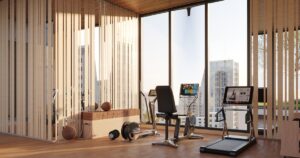
Photo by Ambitious Studio* | Rick Barrett on Unsplash
A wall mounted folding weight bench is the right call for any garage gym under 180 square feet. The RAB Fitness unit is the one to buy. The Merax is the one to skip. The bracket weld is the only spec that matters for long-term use, it is never published anywhere, and the only way to know which side of that line a bench falls on is to own it past the six-month mark. I did that twice so you do not have to.
Buy the RAB Fitness if your garage is tight and you train on the bench four or more days a week. Skip wall-mounted benches entirely if your garage is over 200 square feet and floor space is not a constraint. A standard flat bench at that size is simpler, cheaper, and easier to reposition.
Frequently Asked Questions
Do wall mounted folding weight benches wobble under heavy use?
Budget models with thin bracket welds do develop wobble, typically between months five and eight of regular loading. Units with heavier bracket construction like the RAB Fitness hold firm well past that window.
How much wall space does a folding bench take up when mounted?
Most wall-mounted folding benches need a 48-to-52-inch wide mounting span and sit roughly 5 to 6 inches off the wall when folded. Confirm stud spacing matches the bracket before you order.
Is a wall mounted folding weight bench worth it for a small garage gym?
For garages under 180 square feet, yes. You recover 12 to 15 square feet of floor space compared to a standard flat bench, which in a single-car garage is the difference between a functional layout and a cramped one.
Can you do incline press on a wall-mounted folding bench?
Most adjustable wall-mounted models support incline positions from roughly 30 to 85 degrees. Decline is generally not possible on folding wall benches due to how the bracket pivots.
What studs do I need to mount a wall-mounted folding bench?
Standard 16-inch on-center wood studs handle it fine for benches rated under 700 lbs. For concrete or cinderblock garage walls, you’ll need appropriate anchors rated for the load, not just drywall screws.
If you found the bracket weld issue useful, the same failure pattern shows up in wall-mounted pull-up stations and folding squat racks. A closer look at weld quality across folding rack designs is worth reading before you commit to any wall-mounted load-bearing equipment in your garage setup.

THE WEEKLY VERDICT
Best Gear Picks, Every Week
Jake's honest verdict on home gym gear — what's worth buying and what to skip.
Free. No spam. Unsubscribe anytime.